


Trans, nonbinary, and intersex people share a common struggle not because their experiences are identical, but because all are forced to live under a social order that disciplines bodies, punishes divergence, and enforces rigid categories of sex and gender for the benefit of capitalism and patriarchy. Each group encounters that structure differently. Some face medical gatekeeping and the violence of denied transition care. Some face erasure because their existence unsettles binary norms. Some face invasive regulation and pathologization of their bodies from birth. But these differences do not negate a shared political condition. They reveal different expressions of the same underlying contradiction. The task of revolutionary politics is not to collapse those distinctions into sameness, but to understand them concretely and organize on that basis. A struggle for rights, dignity, and acceptance that excludes trans, nonbinary, or intersex people from one another is not a struggle for liberation at all. It is a fragmented politics that leaves the system itself untouched.
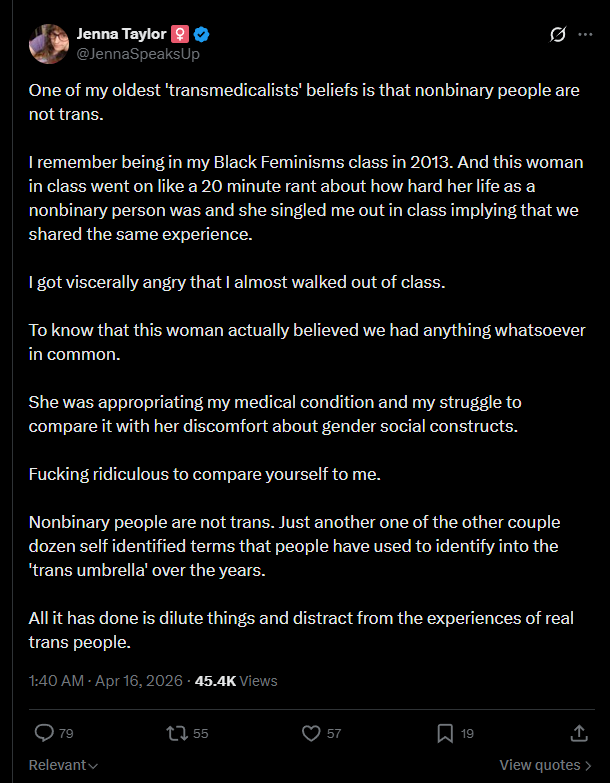
This is exactly why the transmedicalist line pushed by Jenna Taylor and others must be rebuked. This is a reactionary resolution of a real contradiction. The anger Taylor describes is being turned sideways into gatekeeping instead of being directed at the system that produces the conditions both she and nonbinary people are struggling under. Saying “nonbinary people are not trans” doesn’t clarify anything materially, it just draws a line of exclusion and calls it truth. That’s not analysis, but resentment hardened into ideology. The issue Taylor describes in that classroom was a real-time liberal identity politics collapse. That flattening Taylor describes, if it really happened that way, feels like it might have widened the scope a bit much, and it should be criticized if that were the case. However, this occurred in a Black Feminism classroom, and Taylor is white. Furthermore, she turned that moment into a denial of other people’s relationship to gender, thereby reproducing the same bourgeois logic of sorting people into “real” and “fake” categories. Taylor also failed to articulate her point in the moment and instead chose to keep quiet and harbor resentment.
Maoist science demands we locate the contradiction correctly. Binary trans people may choose not to medically transition or medically transition in different ways. Many nonbinary people also choose medical transition. Trans and nonbinary groups are not identical, but oppression of both groups is the product of the same oppressive gender system under capitalism and patriarchy. The task is not to compete over legitimacy, but to distinguish experiences concretely while building unity against the structure that produces them. When Taylor says this experience of hers “dilutes” the struggle, what she's really describing is a lack of political clarity, not the existence of other identities. The solution is sharper analysis, not exclusion. Gatekeeping fragments oppressed people and serves the system by keeping the struggle horizontal. Revolutionary politics requires rejecting both liberal flattening and reactionary dismissal, and instead organizing around the material conditions that shape all of these experiences.
The harm done by transmedicalism is not limited to bad theory or rude rhetoric. It builds a culture of exclusion. It teaches people to measure one another against a hierarchy of legitimacy, pain, and medical recognizability. It rewards proximity to a narrow standard of acceptable transness while casting others outside the boundary of the human and the political. In this way, it establishes a kind of internal apartheid, where some are treated as deserving of protection, recognition, and community, while others are relegated to suspicion, dismissal, or social death. That logic does not defend trans people. It reproduces the very mechanisms used by the state, the medical establishment, and bourgeois society to deny autonomy and divide the oppressed. It poisons collective will by replacing solidarity with policing and replacing struggle with boundary enforcement.
A revolutionary approach has to move in the opposite direction. It must insist that trans, nonbinary, and intersex people have a common enemy in the structures that regulate gender, body, and identity in service of domination. It must make room for concrete differences without transforming them into castes. It must oppose the liberal urge to flatten every experience into one undifferentiated umbrella, but it must oppose just as fiercely the reactionary urge to sort people into “real” and “fake” camps. The point is not to erase contradiction. The point is to struggle through contradiction correctly, in a way that builds unity, deepens analysis, and strengthens the collective fight for liberation. Any politics that cannot do that will remain trapped in resentment, fragmentation, and exclusion. Any politics that can do it has the possibility of becoming a real force.