

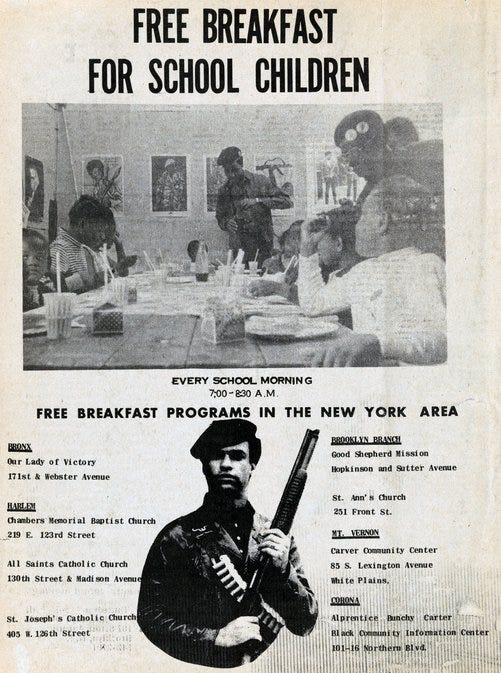
In periods of political reaction, many organizations fall into the trap of confusing survival work with revolutionary work itself. Food drives, rideshares, rapid response networks, legal defense funds, and other mutual aid efforts become treated not as tools for political development, but as ends unto themselves. While these programs can provide real and necessary support, they do not automatically build revolutionary consciousness, organization, or power. Capitalism is fully capable of tolerating isolated acts of compassion so long as they remain disconnected from a broader struggle against the systems producing suffering in the first place. The task of revolutionary organizing is therefore not simply to alleviate crisis, but to transform crisis into political understanding, collective discipline, and durable community organization. Mutual aid without an emphasis on community building and political education risks becoming little more than the compassionate management of decline; mutual aid tied to revolutionary struggle can become the groundwork for something far more dangerous to the existing order.
Today, I examined another piece by Kenny Lake. Overall, what stands out to me about Lake’s arguments is this insistence that revolution has been hollowed out and replaced with politics that are ultimately compatible with the continued existence of bourgeois rule. The article argues that a lot of contemporary “dual power” and “counterpower” organizing in the imperial core mistakes survival programs, local autonomy projects, and horizontal structures for revolutionary strategy itself. That critique hits because it re-centers the question of state power; who rules, through what force, and in whose class interests.
The piece repeatedly pushes the idea that concepts like base areas and the mass line cannot be detached from organized struggle for political power and reduced into activist aesthetics or decentralized lifestyle politics. Its strongest point is probably that communists cannot confuse serving the people with endlessly administering poverty under capitalism. Mutual aid, community programs, and local organizing only become revolutionary when tied to political education, investigation, disciplined organization, and a strategy for actually overthrowing bourgeois power rather than coexisting with it.
This is the same argument I made to our mutual aid group when it first met some months ago, and it was a line I continued to advance in Immigrant Solidarity work here in Cleveland. Our mutual aid networks should be oriented toward political education and community building; true roadwork toward dual power. You cannot build a revolutionary base by simply addressing symptoms of the disease. You have to attack the disease itself, and one way to do this is through inoculation.
A revolutionary organization cannot survive as merely a service provider. If all we do is respond to crises after they happen, provide resources, and then disperse, we remain trapped within the logic of liberal charity. People may appreciate the help, but appreciation alone does not develop class consciousness. The state and NGOs are already capable of administering suffering; what makes revolutionary work distinct is its ability to transform isolated experiences into shared political understanding. That transformation does not happen automatically. It has to be consciously cultivated.
This is why mutual aid projects should function as sites of political development as much as material support. Every eviction defense, Know Your Rights (KYR) training, deportation response, rideshare network, or food distribution effort should deepen people’s understanding of the systems producing those conditions in the first place. The goal is not only to help people survive a reactionary moment, but to inoculate communities against the ideological forces that make those attacks possible; chauvinism, anti-immigrant hysteria, racial resentment, faith in the neutrality of the state, and the deeply individualized logic of capitalism itself.
Inoculation means preparing people politically before crisis sharpens. It means building relationships strong enough that repression and propaganda cannot easily fracture them. It means giving communities a way to come together during times of crisis, alleviating fear. It means creating structures where people learn through participation that solidarity is not charity; it is collective self-defense. A rideshare to court, a rapid response turnout, or a KYR training may seem small in isolation, but each can become an entry point into broader political struggle if handled correctly. The task is to connect immediate needs to systemic analysis and collective action.
That is where the question of dual power actually begins to emerge. Not in the fantasy that a few disconnected autonomous projects somehow “replace” the state on their own, but in the slow construction of organized communities capable of acting independently of bourgeois institutions while developing the political consciousness necessary to confront them. The revolutionary potential of these projects is not located in the service itself; it is located in the relationships, discipline, confidence, and political clarity built through struggle around them.
Without that orientation, mutual aid risks becoming little more than compassionate management of decline. With it, even small defensive efforts can become schools of political education and seeds for more advanced forms of organization later on.
the idea that dual power is a strategic orientation we build, rather than a very specific historical artefact of the concrete historical conditions particular to Russia in the early 1900s is itself an error I also don't see many people correctly grasping at! whoever distorted the concept of "dual power" as like this thing you pursue has also, in my view, contributed a lot to the confusion