

Applying the mass line to organizing within Democratic Socialists of America (DSA) offers a way to move beyond insular activism and toward genuinely rooted, mass-based political work. While DSA is not a revolutionary party in the classical sense, its size, diversity, and local chapter structure make it a fertile ground for experimenting with methods drawn from Mao Zedong’s concept of the mass line.
What Is the Mass Line?
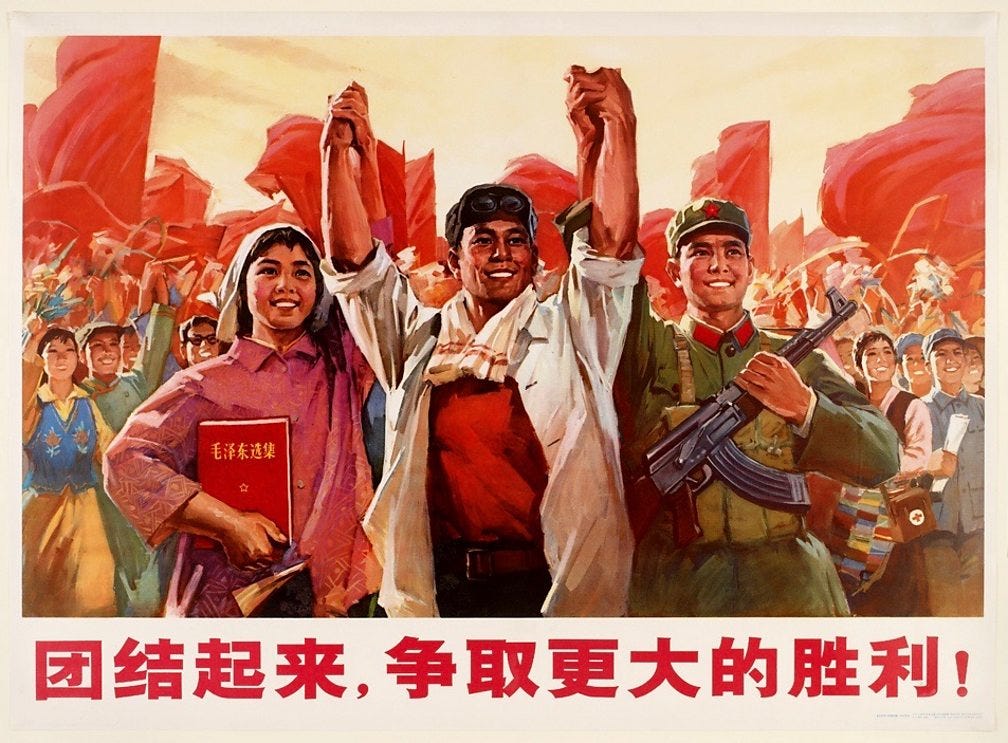
The mass line is a method of leadership and organizing developed through the revolutionary practice of Mao and the Chinese Communist Party. It is often summarized as “from the masses, to the masses,” but this phrase only gestures at a deeper process. The mass line begins from the understanding that the people already possess fragmented, partial, and experience-based knowledge of their own conditions. These ideas exist in an unorganized form, shaped by daily struggle but limited by ideology, isolation, and lack of coordination.
Organizers practicing the mass line do not impose a fully formed program from above. They go among the people and investigate. They listen carefully to what workers, tenants, and community members are already saying about their lives. They gather grievances, desires, and informal analyses. These are then processed through a political framework that can identify the underlying contradictions at work. The organizer’s role is to synthesize these scattered insights into a coherent line that points toward collective action.
That synthesized line is then returned to the people in the form of campaigns, demands, and structures that are both politically advanced and immediately recognizable. If the process is done correctly, people do not experience the program as something foreign. They recognize it as a clearer and more powerful expression of what they already knew in part. Through participation in struggle, their understanding deepens further, which allows the cycle to repeat at a higher level.
The mass line is not a one-time consultation or a branding exercise. It is a continuous cycle of investigation, synthesis, and return. It requires discipline, humility, and a willingness to be transformed by the people one is organizing with. It also requires a break from the idea that political clarity originates primarily in leadership bodies or national committees.
The Problem of Electoralism and the Limits of Reform
Within DSA, much of the organization’s energy has been directed toward electoral campaigns. These efforts have produced some reforms and a layer of elected officials who identify as socialists. However, an overreliance on electoralism risks substituting representation for power.
The structure of the United States state is not neutral. It is the political expression of a capitalist system that is deeply tied to imperial power. From its foundations in settler colonialism and slavery to its present role in maintaining global dominance, the state is not simply an arena that can be gradually repurposed toward socialist ends. It is a machinery designed to reproduce class rule.
Figures like Karl Marx and later revolutionaries argued that the working class cannot simply take hold of the existing state apparatus and wield it for its own purposes. The experience of reform movements in the United States has repeatedly shown that even modest gains are constrained, rolled back, or absorbed into the system. Electoral victories often require compromise, and those compromises tend to dilute the very demands that mobilized people in the first place.
Within DSA, electoral work can create a feedback loop where organizing becomes oriented toward campaigns and candidate viability rather than toward building independent power among the masses. Members are transformed into canvassers and staff rather than organizers rooted in their communities. The horizon of struggle narrows to what is considered politically feasible within existing institutions.
The result is a form of politics that can win positions but struggles to transform the underlying relations of power. It risks producing symbolic victories while leaving the fundamental structures of exploitation intact.
Why Dual Power Must Be the Focus
If electoralism operates within the limits of the existing system, the concept of dual power points toward a different path. Dual power refers to the creation of institutions, practices, and relationships that meet people’s needs while also building their capacity to govern themselves. Dual Power is not simply about providing services, but constructing an alternative basis of power rooted in collective organization.
In the context of DSA, this could take the form of tenant unions that challenge landlord control, workplace organizing that builds worker leadership, and mutual aid networks that move beyond charity toward collective self-reliance. These are not isolated projects. When developed through a mass line approach, they become interconnected sites of struggle that can begin to contest the authority of existing institutions.
The importance of dual power lies in its ability to transform people through participation. Rather than waiting for elected officials to deliver change, people engage directly in shaping their conditions. They develop political consciousness, organizational skills, and a sense of collective agency. These are the foundations of any meaningful challenge to capitalist power.
The argument that the American Empire can be fundamentally transformed from within its own political structures rests on a misunderstanding of how those structures function. The state is not a passive tool. It actively resists efforts that threaten the interests it was built to protect. Repression, co-optation, and bureaucratic limitation are not anomalies. They are built-in features.
This does not mean that electoral work must be abandoned entirely. It can play a tactical role in certain contexts. However, when it becomes the primary focus, it diverts energy away from the slower but more essential work of building mass power. Without that foundation, electoral gains remain fragile and reversible.
The Problem of Organizer-Centric Politics in DSA
Many DSA chapters struggle with a familiar issue. Political direction is often driven by the most active members rather than the broader base. Campaigns can become shaped by ideological preferences, national talking points, or internal meeting culture rather than the lived realities of working people in a given locality.
This dynamic creates a gap between members and the broader class. Campaigns may be well intentioned but fail to resonate. Participation remains limited, and burnout among core organizers becomes common. Without a method for systematically engaging non-members, DSA risks becoming self-referential rather than mass-based.

What the Mass Line Changes in Practice
Applying the mass line shifts the role of a DSA organizer. Instead of primarily advocating pre-formed positions, organizers become investigators, listeners, and synthesizers. They engage in structured conversations, not just to recruit but to understand. They identify patterns in what people are experiencing and develop campaigns that emerge from those patterns.
When done correctly, this process produces organizing that feels grounded and necessary. People are more likely to participate because they see their own lives reflected in the struggle. Campaigns gain durability because they are rooted in real contradictions rather than abstract priorities.
This also creates a feedback loop that strengthens the organization. As more people become involved, the capacity for investigation and action grows. The organization becomes less dependent on a small core and more reflective of the class it seeks to organize.
Toward a Mass Line DSA
For DSA to become a genuinely mass organization, it must reorient its practice. The mass line offers a method for doing so, but it also demands a shift in priorities. Organizing must begin with the people as they are, not as the organization wishes them to be. Political clarity must be developed through engagement, not assumed in advance.
At the same time, the organization must grapple with the limits of electoralism and the necessity of building dual power. Without independent bases of working class organization, electoral gains will remain constrained. Without a mass line approach, even dual power efforts risk becoming disconnected from the people they aim to serve.
The task is not simple. It requires discipline, patience, and a willingness to rethink established habits. But in a moment marked by widespread dissatisfaction and fragmented resistance, it offers a path toward building the kind of rooted, collective power that can move beyond the limits of the present system.
Based. Ty for this.