

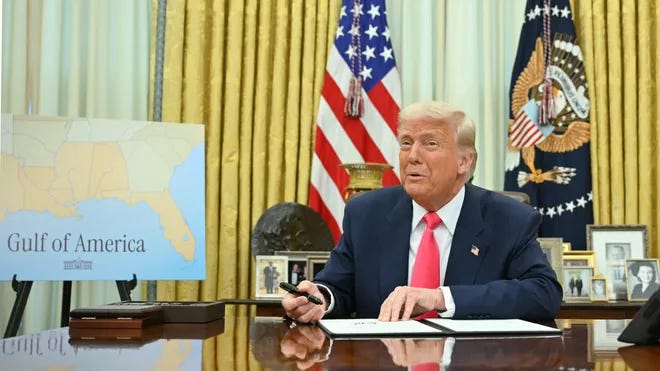
WASHINGTON, D.C. — On Jan. 8, President Donald Trump said the United States would begin targeting drug cartels “by land,” signaling a potential expansion of U.S. operations beyond maritime interdictions. The comments followed a U.S. military operation on Jan. 3, 2026, that resulted in the capture of Venezuelan President Nicolás Maduro.
Trump and some members of his inner circle, including Sen. Marco Rubio and Sen. Ted Cruz, have previously suggested the possibility of military action against drug cartels in Mexico. Critics say such rhetoric threatens Mexico’s sovereignty, though no formal plan for U.S. ground or air operations inside Mexico has been announced.
Trump’s remarks on Jan. 8 were among his most explicit to date.
“Mexico has to get their act together because they’re pouring through Mexico and we’re going to have to do something,” Trump said. “We’d love Mexico to do it. They’re capable of doing it. But unfortunately the cartels are very strong in Mexico.”
The U.S. military has recently expanded naval operations in the Caribbean and international waters off the coasts of Venezuela and Colombia. Critics, including some South American political leaders, have described those actions as examples of “gunboat diplomacy,” while U.S. officials have defended them as lawful counter-narcotics and security operations.
Mexican and international observers have also pointed to last year’s anti-MORENA protests in Mexico City, including attempts by small groups to breach the National Palace. While the U.S. government has denied any involvement, some critics in Mexico have characterized the unrest as a failed attempt at destabilization, a claim not supported by evidence and rejected by U.S. officials.
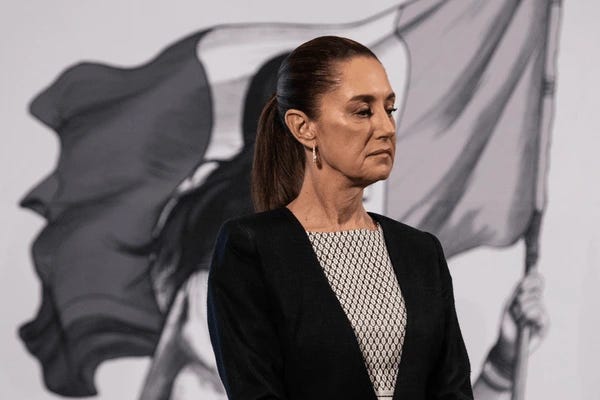
President Claudia Sheinbaum Pardo has publicly dismissed threats of U.S. military action as unlikely and reaffirmed Mexico’s sovereignty. Sheinbaum has repeatedly said Mexico will not permit foreign military intervention on its soil and described sovereignty and the self-determination of people as fundamental principles of international law.
In response to President Donald Trump’s comments about taking action against drug cartels, Sheinbaum said Mexico seeks coordination and collaboration with the United States on security and drug-trafficking issues but will not accept outside military forces operating on Mexican territory. She has described the idea of a U.S. invasion as not something she believes is being seriously considered by Washington.
Sheinbaum said, “I don’t believe in an invasion; I don’t think it’s something they take seriously,” and emphasized that cooperation must respect Mexico’s constitutional commitment to non-intervention.
Mexico’s government has also stressed strong bilateral cooperation on law-enforcement efforts with the United States while firmly rejecting any notion of military intrusion into its territory.
A significant share of Mexicans oppose U.S. military action inside Mexico, viewing it as a violation of national sovereignty. Mexican officials and political commentators have pointed to longstanding sensitivities rooted in past U.S. interventions, including the Mexican-American War of the 1840s, in which Mexico lost roughly half of its territory.
Public opinion is divided, however. A recent poll by the newspaper El Financiero found that about one-third of respondents said they support the deployment of U.S. military forces in Mexico to combat drug cartels, while a majority said they oppose such action.
Facts of American intervention, such as those in recent memory like the invasion of Iraq, Afghanistan, interdictions in Yemen, and Pakistan, indicate that the American agenda is one of control over resources and land. The American Empire is self-serving, and would likely conduct the same exploitative operations in Mexico as it has done elsewhere. Venezuela is now threatened with further military action if it does not meet American resource demands, and the last thing Mexico needs to do right now is enter into a new era of colonialism.